Showing posts with label InternetOfThings. Show all posts

Sunday, December 29, 2019

The Allure of the Smart Home

What exactly is a smart home, and why would I want to live in one?

I don't think the smart home concept is just about having the latest cool technology or containing some smart stuff. And many of the most commonly discussed examples of smart technology in the home seem to be merely modest improvements on earlier technologies, rather than something entirely new.

Let's look at some smart devices you might have in your home. Programmable thermostats have been available for ages, adjusting heating and/or air conditioning to maintain a comfortable temperature at certain times of day. Modern heating systems can now offer separate controls for each room, and be programmed to reduce your total energy consumption: such systems are typically marketed as intelligent systems. So whatever smart technology is doing in this area looks more like useful improvement than radical change.

Or how about remote control functionality. Remote control devices have been around for a long time, especially for couch potatoes who wished to change TV channels without the effort of walking a few feet across the room. Now we have voice-activated controls, for people who can't even be bothered to search under the cushions for the remote control device. Voice activation may be a bit more technologically sophisticated than pushing buttons, and some artificial intelligence may be required to recognize and interpret the voice commands, but it's basically the same need that is being satisfied here.

Or how about a chatbot to answer your questions? In most cases, the answers aren't hard-wired into the device, but are pulled from some source outside the home. So the chatbot is merely a communication device, as if you had a telephone hotline to Stephen Fry only faster and always available, like several million Stephen Fry clones working in parallel around the clock. (You may choose any other  knowledgeable and witty celebrity if you prefer.)

And the idea that having a chatbot device in your home makes the home itself smart is like thinking that having a smartphone in the pocket of your trousers turns them into smart trousers. Or that having Stephen Fry's phone number attached to your fridge door turns it into a smart fridge.

Of course, a smart system may have multiple components - different classes of device. You might install an intelligent security system, using cameras and other devices, to recognize and admit your children and pets, while keeping the home safe from unwanted visitors.

But surely the concept of smart home means more than just having a number of smart parts or subsystems, it implies that the home itself manifests some intelligence at the whole-system level. The primary requirement seems to be that these smart devices are connected, not to the world outside the home, but to each other, enabling them to orchestrate things. Not just home automation, but seamless home automation.

For example, suppose I make my home responsible for getting me to work on time. My home computer could monitor the traffic reports or disruption on public transport, check with my car whether I needed to allow extra time to refuel, send a message to my alarm clock to wake me up at the optimal time, having also instructed the heating system when to switch the boiler on.

Assuming I do not wish my movements to be known in advance by burglars and kidnappers, all of these messages need to be secure against eavesdropping. It isn't obvious to me why it would be necessary to transmit these messages via servers outside my house. Yes I know it's called the internet of things, but does that mean everything has to go via the internet?

Well yes apparently it does, if we follow the recently announced Connected Home over IP (CHIP) standards, to be developed jointly by Amazon, Apple, Google, and most of the other key players in the smart home market.

Many of those who commented on the Register article raised concerns about encryption. It seems unlikely at this point that the tech giants will be keen on end-end encryption, because surely they are going to want to feed your data into the hungry mouths of their machine learning starlings. So whatever security measures are included in the CHIP standards, they will probably represent a compromise, appearing to take security seriously but not seriously impeding the commercial and strategic interests of the vendors. Smart for them, not necessarily for us.

Sometimes it seems that the people who benefit most from the smart home are not those actually living in these homes but service providers, using your data to keep an eye on you. For example, landlords:
Smart home technology is an alluring proposition for the apartment industry: Provide renters with a home that integrates with and responds to their lifestyle, and ­increase rents, save on energy, and collect useful resident population data in return. Kayla Devon
Internet-connected locks and facial recognition systems have raised privacy concerns among tenants across the country. A sales pitch directed at landlords by a smart-home security company indicates that the technology could help them raise rental prices and potentially get people evicted. Alfred Ng
We should pass a law that would hold smart access companies to the highest possible standard while making certain that their technology is safe, secure and reliable for tenants. Michael McKee

Energy companies have been pushing smart meters and other smart technologies, supposedly to help you reduce your energy bills, but also to get involved in other aspects of your life. For example, Constellation promotes the benefits of smart home technology for maintaining the independence of the elderly, while Karen Jorden mentions the possibility of remote surveillance by family members living elsewhere.
Smart technology that recognizes patterns, such as the morning coffee-making routine mentioned earlier, could come in handy when those patterns are broken, perhaps alerting grown children that something may be amiss with an elderly parent. Karen Jordan

As Ashlee Clark Thompson points out, this kind of remote surveillance can benefit the children as well as the parents, providing peace of mind as well as reducing the need for physical visits to check up. 

And doubtless the energy companies have other ideas as well. According to Ross Clark

Scottish and Southern Electricity Networks has proposed a system in which it will be able to turn off certain devices in our homes ... when the supply of electricity is too small to meet demand.

Finally, Ian Dunt grumbled that his smart thermostat was like having a secret flatmate.

and got dozens of Tweets in reply, from people with similar frustrations.

So we keep coming back to the fundamental ethical question: Whom shall the smart home serve?


Footnote May 2021

Some legal advice for landlords just in from US law firm Orrick: "Tenant data may be an attractive source of new revenue, but landlords should proceed with caution" (13 May 2021). They also note that "New York City Council has enacted a Tenant Data Privacy Act that is poised to enhance privacy protections in multifamily buildings in the city" (27 May 2021).


Dieter Bohn, Situation: there are too many competing smart home standards. Surely a new one will fix it, right? (The Verge, 19 Dec 2019)

Ross Clark, The critics of smart meters were right all along (Telegraph, 19 September 2020) HT @tprstly

Constellation, Smart Homes Allow the Aging to Maintain Independence (published 20 July 2018 updated 13 August 2018)

Kayla Devon, The Lure of the Smart Apartment (MFE, 31 March 2016)

Karen Jordan, Set It And Forget It: The Lure Of Smart Apartments (Forbes, 28 August 2017)

Kieren McCarthy, The IoT wars are over, maybe? Amazon, Apple, Google give up on smart-home domination dreams, agree to develop common standards (The Register, 18 Dec 2019)

Michael McKee, Your Landlord Could Know That You’re Not at Home Right Now (New York Times, 17 December 2019)

Alfred Ng, Smart home tech can help evict renters, surveillance company tells landlords (CNET, 25 October 2019)

Ashlee Clark Thompson, Persuading your older parents to take the smart home leap (CNET, 11 April 2017)

Shannon Yavorsky and David Curtis, Unlocking the Value of Tenant Data (Orrick 13 May 2021), Home Alone? New York City Enacts Tenant Data Privacy Act ( Orrick 27 May 2021) HT @christinayiotis


Related posts: Understanding the Value Chain of the Internet of Things (June 2015), Defeating the Device Paradigm (Oct 2015), Hidden Functionality (February 2019), Towards Chatbot Ethics - Whom does the chatbot serve? (May 2019), Driverless cars - Whom does the technology serve? (May 2019), The Road Less Travelled - Whom does the algorithm serve? (June 2019)


 Updated 16 November 2020, 29 May 2021

Sunday, February 24, 2019

Hidden Functionality

Consumer surveillance was in the news again this week. Apparently Google forgot to tell consumers that there was a cuckoo microphone in the Nest.

So what's new? A few years ago, people were getting worried about a microphone inside the Samsung Smart TV that would eavesdrop your conversations. (HT @Parker Higgins)

But at least in those cases we think we know which corporation is responsible. In other cases, this may not be so clear-cut. For example, who decided to install a camera into the seat-back entertainment systems used by several airlines?

And there is a much more general problem here. It is usually cheaper to use general-purpose hardware than to design special purpose hardware. For this reason, most IoT devices have far more processing power and functionality than they strictly need. This extra functionality carries two dangers. Firstly, if when the device is hacked, the functionality can be coopted for covert or malicious purposes. (For example IoT devices with weak or non-existent security can be recruited into a global botnet.) Secondly, sooner or later someone will think of a justification for switching the functionality on. (In the case of the Nest microphone Google already did, which is what alerted people to the microphone's existence.)

So who is responsible for the failure of a component to act properly, who is responsible for the limitation of purpose, and how can this responsibility be transparently enforced?

Some US politicians have started talking about a technology version of "food labelling" - so that people can avoid products and services if they are sensitive to a particular "ingredient". With physical products, this information would presumably be added to the safety leaflet that you find in the box whenever you buy anything electrical. With online services, this information should be included in the Privacy Notice, which again nobody reads. (There are various estimates about the number of weeks it would take you to read all these notices.) So clearly it is unreasonable to expect the consumer to police this kind of thing.

Just as the supermarkets have a "free from" aisle where they sell all the overpriced gluten-free food, perhaps we can ask electronics retailers to have a "connectivity-free" section, where the products can be guaranteed safe from Ray Ozzie's latest initiative, which is to build devices that connect automatically by default, rather than wait for the user to switch the connectivity on. (Hasn't he heard of privacy and security by default?)

And of course high-tech functionality is no longer limited to products that are obviously electrical. The RFID tags in your clothes may not always be deactivated when you leave the store. And for other examples of SmartClothing, check out my posts on Wearable Tech.


Nick Bastone, Google says the built-in microphone it never told Nest users about was 'never supposed to be a secret' (Business Insider, 19 February 2019)

Nick Bastone, Democratic presidential candidates are tearing into Google for the hidden Nest microphone, and calling for tech gadget 'ingredients' labels (Business Insider, 21 February 2019)

Ina Fried, Exclusive: Ray Ozzie wants to wirelessly connect the world (Axios, 22 February 2019)

Melissa Locker, Someone found cameras in Singapore Airlines’ in-flight entertainment system (Fast Company, 20 February 2019)

Ben Schoon, Nest Secure can now be turned into another Google Assistant speaker for your home (9 to 5 Google, 4 February 2019)

Related posts: Have you got Big Data in your Underwear? (December 2014), Towards the Internet of Underthings (November 2015), Pax Technica - On Risk and Security (November 2017), Outdated Assumptions - Connectivity Hunger (June 2018), Shoshana Zuboff on Surveillance Capitalism (February 2019)

Sunday, December 03, 2017

IOT is coming to town

You better watch out


#WatchOut Analysis of smartwatches for children (Norwegian Consumer Council, October 2017). BoingBoing comments that
Kids' smart watches are a security/privacy dumpster-fire.

Charlie Osborne, Smartwatch security fails to impress: Top devices vulnerable to cyberattack (ZDNet, 22 July 2015)

A new study into the security of smartwatches found that 100 percent of popular device models contain severe vulnerabilities.

Matt Hamblen, As smartwatches gain traction, personal data privacy worries mount (Computerworld, 22 May 2015)
Companies could use wearables to track employees' fitness, or even their whereabouts. 


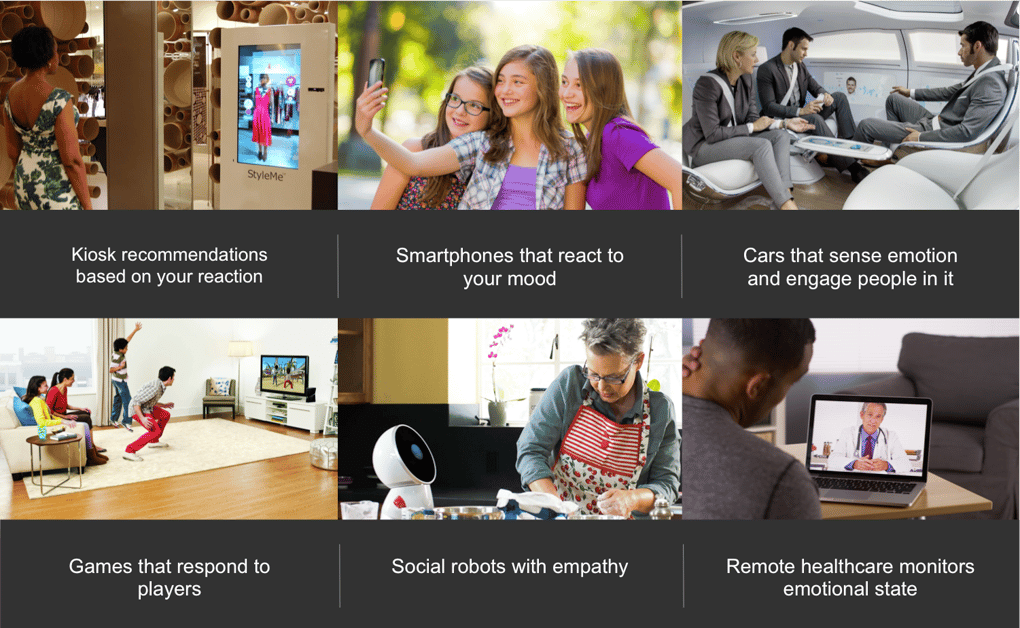
You better not cry

Source: Affectiva


Rana el Kaliouby, The Mood-Aware Internet of Things (Affectiva, 24 July 2015)

Six Wearables to Track Your Emotions (A Plan For Living)

Soon it might be just as common to track your emotions with a wearable device as it is to monitor your physical health. 

Anna Umanenko, Emotion-sensing technology in the Internet of Things (Onyx Systems)


Better not pout


Shaun Moore, Fooling Facial Recognition (Medium, 26 October 2017)

Mingzhe Jiang et al, IoT-based Remote Facial Expression Monitoring System with sEMG Signal (IEEE 2016)

Facial expression recognition is studied across several fields such as human emotional intelligence in human-computer interaction to help improving machine intelligence, patient monitoring and diagnosis in clinical treatment. 


I'm telling you why


Maria Korolov, Report: Surveillance cameras most dangerous IoT devices in enterprise (CSO, 17 November 2016)

Networked security cameras are the most likely to have vulnerabilities. 

Leor Grebler, Why do IOT devices die (Medium, 3 December 2017)

IOT is coming to town


Nick Ismail, The role of the Internet of Things in developing Smart Cities (Information Age, 18 November 2016)


It's making a list And checking it twice


Daan Pepijn, Is blockchain tech the missing link for the success of IoT? (TNW, 21 September 2017)


Gonna find out Who's naughty and nice


Police Using IoT To Detect Crime (Cyber Security Intelligence, 14 Feb 2017)

James Pallister, Will the Internet of Things set family life back 100 years? (Design Council, 3 September 2015)


It sees you when you're sleeping It knows when you're awake


But don't just monitor your sleep. Understand it. The Sense app gives you instant access to everything you could want to know about your sleep. View a detailed breakdown of your sleep cycles, see what happened during your night, discover trends in your sleep quality, and more. (Hello)

Octav G, Samsung’s SLEEPsense is an IoT-enabled sleep tracker (SAM Mobile, 2 September 2015)


It knows if you've been bad or good So be good for goodness sake!


US intelligence chief: we might use the internet of things to spy on you (The Guardian, 9 Feb 2015)

Ben Rossi, IoT and free will: how artificial intelligence will trigger a new nanny state (Information Age, 7 June 2016)


Twitter Version


Related Posts

Pax Technica - The Book (November 2017)
Pax Technica - The Conference (November 2017)
Pax Technica - On Risk and Security (November 2017)
The Smell of Data (December 2017)

Updated 10 December 2017

Saturday, November 25, 2017

Pax Technica - On Risk and Security

#paxtechnica Some further thoughts arising from the @CRASSHlive conference in Cambridge on The Implications of the Internet of Things. (For a comprehensive account, see @LaurieJ's livenotes.)

Many people are worried about the security implications of the Internet of Things. The world is being swamped with cheap internet-enabled devices. As the manufacturing costs, size and power consumption of these devices are being driven down, most producers have neither the expertise not the capacity to build any kind of security into them.

One of the reasons why this problem is increasing is that it is cheaper to use a general-purpose chip than to design a special purpose chip. So most IoT devices have far more processing power and functionality than they strictly need. This extra functionality can be then coopted for covert or malicious purposes. IoT devices may easily be recruited into a global botnet, and devices from some sources may even have been covertly designed for this purpose.

Sensors are bad enough - baby monitors and sex toys. Additional concerns apply to IoT actuators - devices that can produce physical effects. For example, lightbulbs that can flash (triggering epileptic fits), thermostats that can switch on simultaneously across a city (melting the grid), centrifuges that can spin out of control (attempting to sabotage Iran's nuclear capability).

Jon Crowcroft proposed that some of this could be addressed in terms of safety and liability. Safety is a useful driver for increased regulation, and insurance companies will be looking for ways to protect themselves and their corporate customers. While driverless cars generate much discussion, similar questions of safety and liability arise from any cars containing significant quantities of new technology. What if the brake algorithm fails? And given the recent history of cheat software by car manufacturers, can we trust the car not to alter the driver logs in order to evade liability for an accident?

In many cases, the consumer can be persuaded that there are benefits from internet-enabled devices, and these benefits may depend on some level of interoperability between multiple devices. But we aren't equipped to reason about the trade-off between accessibility/usability and security/privacy.

For comparison's sake, consider a retailer who has to decide whether to place the merchandise in locked glass cases or on open shelves. Open shelves will result in more sales, but also more shoplifting. So the retailer locks up the jewelry but not the pencils or the furniture, and this is based on a common-sense balance of value and risk.

But with the Internet of Things, people generally don't have a good enough understanding of value and risk to be able to reason intelligently about this kind of trade-off. Philip Howard advises users to appreciate that devices "have an immediate function that is useful to you and an indirect function that is useful to others" (p255). But just knowing this is not enough. True security will only arise when we have the kind of transparency (or visibility or unconcealment) that I referenced in my previous post.


Related Posts

Defeating the Device Paradigm (October 2015)
Pax Technica - The Book (November 2017)
Pax Technica - The Conference (November 2017)
The Smell of Data (December 2017)
Outdated Assumptions - Connectivity Hunger (June 2018)


References

Cory Doctorow, The Coming War on General Computation (2011)

Carl Herberger, How hackers will exploit the Internet of Things in 2017 (HelpNet Security, 14 November 2016)

Philip Howard, Pax Technica: How The Internet of Things May Set Us Free or Lock Us Up (Yale 2015)

Laura James, Pax Technica Notes (Session 1, Session 2, Session 3, Session 4)

Holly Robbins, The Path for Transparency for IoT Technologies (ThingsCon, June 2017)

Jack Wallen, Five nightmarish attacks that show the risks of IoT security (ZDNet, 1 June 2017)

Sunday, November 19, 2017

Pax Technica - The Book

In preparation for a @CRASSHlive conference in Cambridge this coming week (Pax Technica: The Implications of the Internet of Things), I've been reading Philip Howard's book, subtitled How The Internet of Things May Set Us Free or Lock Us Up.

I'm going to start my review by quoting Howard's definition of his subject.
The "internet of things" consists of human-made objects with small power supplies, embedded sensors, and addresses on the internet. Most of these networked devices are everyday items that are sending and receiving data about their conditions and our behavior. Unlike mobile phones and computers, devices on these networks are not designed for deliberate social interaction, content creation, or cultural consumption. The bulk of these networked devices simply communicate with other devices: coffeemakers, car parts, clothes, and a plethora of other products. This will not be an internet you experience through a browser. Indeed, as the technology develops, many of us will be barely aware that so many objects around us have power, are sensing, and are sending and receiving data. Howard p xi
IoT experts may quibble with some of the details of this definition, but it broadly makes sense.


My first problem with Howard's book is that he doesn't stick to this definition. He talks a lot about devices in general, but most of the time he is talking about other kinds of devices, such as mobile phones and chatbots. The book contains a wealth of reporting on the disruption caused by digital networks. But much of this is not about the internet of things as he defines it, but about social media, big data, fake news and other internet phenemena. These are important topics to be sure, which have been excellently addressed by other sociologists such as Zeynep Tufekci, as well as in the previous CRASSH conference Power Switch. But the book claims to be about something different.


My second problem with Howard's book is that he doesn't really question the notion of "device". There is a considerable literature on the philosophy of technology going back to Heidegger via Herbert Dreyfus and Albert Borgmann. In his introduction to Heidegger's Question Concerning Technology, William Lovitt summarizes Heidegger's position as follows.
In our time, things are not even regarded as objects, because their only important quality has become their readiness for use. Today all things are being swept together into a vast network in which their only meaning lies in their being available to serve some end that will itself also be directed towards getting everything under control. QT p xxix

Albert Borgmann introduced the notion of the Device Paradigm to analyse the way technological devices are perceived and consumed in modern society. In many situations, there is a fetish of the device, obscuring the network infrastructure that is required to deliver the affordance or commodity of the device.

One of the consequences of this is that discussion of the internet of things tends to focus on the things rather than the internet of. At a healthcare event I attended a couple of years ago, various technology companies were exhibiting a range of wearable or implantable devices - some monitoring, some actively intervening. A patient with multiple conditions might be wearing several such devices. But these devices don't and currently cannot communicate with one other (as suggested by Howard's definition quoted above). Instead, as Howard acknowledges is the case for most devices, they are designed to report data back to designers, manufacturers, and third party analysts (p 211) - either directly or via an app on the user's smartphone. So that's basically a hub and spoke network.

To thrive in the Pax Technica, Howard advises, you can be a more sophisticated user ... you can be a functionally prominent political actor by thoughtfully managing your internet of things (p 254-5). But what would that entail? Holly Robbins talks about a language to unmask the complexity of IoT. In 1986, before I had read any Heidegger or Borgmann, I called this Visibility. Heidegger calls it Unconcealment (Unverborgenheit).

Borgmann's own approach is based on what he calls focal things and practices. As Wendt argues, the Internet of Things must create meaningful interactions in order to succeed.

... something found in all of us: the need to take an active role in the world, to shape and design things, and to form rituals around activities. This is not to say we can’t do these things with smart objects, but it does underscore the importance of conscious, embodied interaction with things. The Internet of Things will only be successful if products are designed with purpose. Wendt

So I'm hoping that these aspects of the Internet of Things will be discussed on Friday ...


Related Posts


Understanding the Value Chain of the Internet of Things (June 2015)
Some marketing experts are seeing the Internet of Things as a way of reasserting control over the consumer. 

Defeating the Device Paradigm (Oct 2015)
The Internet of Things is not a random collection of devices. It is a safety-critical system of systems, and must be understood (and regulated) as such. But it often suits certain commercial interests to focus our attention on the devices and away from the rest of the system. This is related to what Borgmann calls the Device Paradigm. 

Towards the Internet of Underthings (Nov 2015)
We are now encouraged to account for everything we do: footsteps, heartbeats, posture. Until recently this kind of micro-attention to oneself was regarded as slightly obsessional, nowadays it seems to be perfectly normal. And of course these data are collected, and sent to the cloud, and turned into someone else's big data. (Good luck with those privacy settings, by the way.)
Pax Technica - The Conference (November 2017)
Pax Technica - On Risk and Security (November 2017)

Ethics of Transparency and Concealment (October 2019)


References


Albert Borgmann, Technology and the Character of Contemporary Life (Chicago, 1984)

Oliver Christ, Martin Heidegger‘s Notions of World and Technology in the Internet of Things age (Asian Journal of Computer and Information Systems, Volume 03– Issue 02, April 2015)

Martin Heidegger, The Question Concerning Technology (Harper, 1977), with introduction by William Lovitt

Philip Howard, Pax Technica: How The Internet of Things May Set Us Free or Lock Us Up (Yale 2015)

Holly Robbins, The Path for Transparency for IoT Technologies (ThingsCon, June 2017)

Zeynep Tufekci, Engineering the public: Big data, surveillance and computational politics (First Monday, Volume 19, Number 7, 7 July 2014)

Richard Veryard, The Role of Visibility in Systems (Human Systems Management 6, 1986)

Thomas Wendt, Internet of Things and the Work of the Hands (UX Magazine, 12 March 2014)

Wikipedia: Device Paradigm

Saturday, November 14, 2015

Towards the Internet of Underthings

#WearableTech #InternetOfThings Once upon a time, the wires in an undergarment merely provided structural support. Now, people may have all sorts of wires and wireless devices hidden under their clothing. Here are some interesting examples.

  • The Foxleaf Bra delivers cancer-fighting drugs through the wearer's skin.
  • An aunt’s death led Kemisola Bolarinwa to develop a wearable device that can pick up Nigeria’s most common cancer much earlier.
  • The @tweetingbra reminds women to examine themselves. (?)
  • The Lumo Lift helps improve posture through app-enabled coaching.
  • Various manufacturers (including Clothing+, OMsignal and SmartLife) produce health vests and sportswear packed with monitors to track your heart rate, breathing rate and the amount of calories you've burnt.

We are now encouraged to account for everything we do: footsteps, heartbeats, posture. Until recently this kind of micro-attention to oneself was regarded as slightly obsessional, nowadays it seems to be perfectly normal. And of course these data are collected, and sent to the cloud, and turned into someone else's big data. (Good luck with those privacy settings, by the way.)

If a device is classed as a medical device, it will be subject to various forms of accreditation and regulation. For this reason, many device makers will be careful to avoid any specific medical claims, but devices that offer some health advice are considered a borderline area.

Another borderline area is hi-tech underpants that protect men from the evil rays allegedly produced by all those wireless devices. Especially the radiation from mobile phones. (Including the Bluetooth that links your underwear to your smartphone.) One brand of underpants that claims to use a mesh of pure silver to create a Faraday cage around the genitals has been banned by the UK Advertising Standards Authority from making any medical claims.

Or maybe you could just switch the whole lot off.


The Wearable Medical Device in Your Future…Is Now! (Marketing Research Association, 28 April 2015)

Jennie Agg, The hi-tech bra that helps you beat breast cancer - and other clothes that can treat or prevent illness (Daily Mail, 10 March 2015)

Valentine Benjamin, Can a bra detect breast cancer? This Nigerian entrepreneur thinks so (Guardian, 9 Aug 2023)

Sarah Blackman, Student designs cancer-fighting bra (Lingerie Insight, 10 Feb 2015)

Britta O'Boyle, SmartLife clothing claims to make sure you never miss a beat (Pocket-Lint, 12 March 2015) 

Rob Crilly, Hi-tech pants "protect sperm from phone waves" (Telegraph 22 October 2014)

Julie Papanek, How Wearable Startups Can Win Big In The Medical Industry (TechCrunch, 19 Feb 2015)

Hannah Jane Parkinson, Lumo Lift review: posture-tracking gadget is a straight shooter (Guardian, 14 November 2014) 

Helen Popkin, Tweeting bra exposed: Genuine support or publicity lift? (NBC News 25 October 2013)

Meera Senthilingam, How a high-tech bra could be your next doctor (CNN, 11 May 2015)

Brendan Seibel, High-Tech Underwear for Adventurous Geeks (21 April 2010)

Mark Sweney, Hi-tech underwear advert banned (Guardian 13 August 2014)

Dan Sung, World Cancer Day - The Real Wonderbra (Wearable, 14 Feb 2015)  


Related Posts Have you got big data in your underwear (December 2014)

Tuesday, October 13, 2015

Defeating the Device Paradigm

Until recently, many people were unfamiliar with the term "defeat device". Following the public disgrace of Volkswagen, it is now believed that a wide range of cars, flat screen TVs and goodness knows what other consumer devices may have been programmed to alter their performance when they detect an official test.

There is a fundamental problem with the regulation of embedded software, which can be captured by a maxim from Arthur Weasley (in Harry Potter and the Chamber of Secrets).

"Never trust anything that can think for itself if you can't see where it keeps its brain." 

As fans of J.K. Rowling will know, Arthur Weasley is a fictional regulator, working for the Misuse of Muggle Artefacts Office at the Ministry of Magic. (Rowling's portrayal of bureaucrats and regulators often verges on the satirical.) Several writers had cited the Weasley maxim in discussions of the Internet of Things even before the Volkswagen story broke - for example Richard Brooker and Kieron O'Hara. As Brooker asks
"How do we make an informed assessment of trust and risk when using a device or service, but with little insight or even awareness of the smart, connected actions that it’s performing in the background, and the information it’s sensing from our interaction and where that information is being sent or used?"

Many people think that regulating the Internet of Things is merely about regulating the devices (the "Things").

But this neglects the importance role of background processes and systems. The Things that make up the Internet of Things are connected to a network, which may be run by a commercial organization for its own commercial purposes.

Take for example a telemonitoring device in a car, which sends location data to a central controller - perhaps controlled by the car company, or an insurance company, or a contractor working for the prison service. This might be part of a car maintenance scheme or a PayAsYouDrive insurance scheme, or a prisoner release system, or perhaps all of the above, but you can't tell this just from inspecting the monitoring device. You have to look at the central controller (the "Brain"), because this is where the signals from the device are processed.

But how should a regulator approach the challenge of testing and monitoring the central processing unit (the "Brain")? Which (for all we know) may be able to detect whether it is being tested, and repurpose the local devices accordingly.

Some writers have argued that Open Source provides the only way to be confident that software is cheat-free. However, two months before the Volkswagen story broke, the US Environment Protection Agency explicitly invoked the Digital Millennium Copyright Act to ban independent experts from testing engine software. As far as I can see, this would prevent the kind of compromise proposed by Kuntal Sampat, which would involve inspecting the interfaces and service calls, as well as full-blown Open Source.

The Internet of Things is not a random collection of devices. It is a safety-critical system of systems, and must be understood (and regulated) as such. But it often suits certain commercial interests to focus our attention on the devices and away from the rest of the system. This is related to what Borgmann calls the Device Paradigm.


Ryan Beene, VW emissions ‘defeat device’ isn’t the first (MarketWatch 25 Sept 2015)

Richard Brooker, Can we trust the Internet of (Unsecure) Things? (BT, 7 October 2014) 

Robert Charette, Volkswagen scandal by crooked software (Cutter Consortium, 8 October 2015) (paywall)

Alex Davies, The EPA opposes rules that could've exposed VW's cheating (Wired 18 September 2015)

Terry Fagen, Why Defeat Software Will Never be Used in Medical Devices (Linked-In, 24 September 2015)

James Grimmelmann, Harry Potter and the Mysterious Defeat Device (Slate 22 September 2015)

Russell Hotten, Volkswagen: The scandal explained (BBC News 25 September 2015)

Leo Kelion, VW: Calls to let car software be examined by experts (BBC News 23 September 2015)

Arthur Neslen, Samsung TVs appear less energy efficient in real life than in tests (Guardian 1 October 2015)

Kieron O’Hara, The Fridge’s Brain Sure Ain’t the Icebox (IEEE Internet Computing, Nov/Dec 2014)

Kuntal Sampat, Defeat Device and Open Source (Blogspot 23 September 2015)

Kit Walsh, Researchers Could Have Uncovered Volkswagen’s Emissions Cheat If Not Hindered by the DMCA (Electronic Frontier Foundation, 21 September 2015)

When Code can Kill or Cure (Economist 2 June 2012)

Wikipedia: Defeat Device, Device Paradigm, Life-Critical System


Related Posts

Tethering (August 2004)

Understanding the Value Chain of the Internet of Things (June 2015)

The New Economics of Manufacturing (November 2015) 

Uber's Defeat Device and Denial of Service (March 2017)

The Road Less Travelled - Whom Does the Algorithm Serve? (June 2019),

Wednesday, June 24, 2015

Understanding the Value Chain of the Internet of Things

#InternetOfThings Unfortunately, I shall be unable to use my ticket for the Unicom conference in London next week. (Any reasonable offer considered.) So here are some thoughts in absentia.


Many of the popular examples of IoT suggest a fairly conventional data collection and monitoring process, in which internet-enabled "things" send signals to a central point, from where an intelligent response can be mobilized.

For example, a car manufacturer installs devices to monitor car performance. Or a warehouse installs temperature monitoring and control devices into every fridge. Or a healthcare provider implants a device to monitor's the patient's blood sugar.

In some cases, the devices may be programmed to perform certain actions automatically - for example, to adjust the fuel mix or temperature, or administer a dose of insulin - but these actions are ultimately the responsibility of the provider of the device.

Who is the "owner" of this device? Although the driver or the patient may have paid for the device and will want some benefit in return, the device is also serving the purpose of the organization that provided it, which should have a clear business case and cost justification to cover all the direct and indirect costs incurred.

Some marketing experts are seeing the Internet of Things as a way of reasserting control over the consumer. J Walker Smith talks enthusiastically about what he calls the Pivot to Passive.

"The pivot to passive automates activities that consumers used to do themselves, from monitoring, to researching, to reporting, to deciding. The fundamental nature of this pivot is a shift from screens to sensors. Consumers are better able to tailor their experiences, but they do so through less, not more control, relinquishing influence and authority to technologies. In turn, these are the very same technologies with which marketers are regaining control in the marketplace."
J Walker Smith, The Pivot to Passive (pdf) (Market Leader Q3, June 2014) 


More complex situations may introduce greater multi-sidedness. For example, the monitoring devices in the car may also be sending signals to an insurance company, as part of a Pay-As-You-Drive policy.

Here's the challenge. In a multi-sided situation, the business case may only turn positive when you aggregate the benefits across multiple purposes. So the innovation requires a new business model to orchestrate the costs and benefits (and risks) between all the stakeholders. A new business model introduces changes to the value network, and typically involves the creation of some kind of commercial platform.

Many of the most interesting innovations of recent years have been characterized by radical disruption to the value network. If the Internet of Things proves to be as disruptive as many people expect, I expect it to be the network where the most fundamental disruption will take place.
"In our time, things are not even regarded as objects, because their only important quality has become their readiness for use. Today all things are being swept together into a vast network in which their only meaning lies in their being available to serve some end that will itself also be directed towards getting everything under control." 
Heidegger, The Question Concerning Technology


Understanding the Value Chain of the Internet of Things was at the London Kensington Hilton on 2nd July 2015.


Related Posts

Defeating the Device Paradigm (Oct 2015), Towards Chatbot Ethics (May 2015)

Wednesday, December 10, 2014

Have you got big data in your underwear?

Apparently, women's breasts aren't all the same. (Who knew?) True+Co. uses an algorithm based on customer feedback to recommend comfortable and flattering bras for its customers. A visitor to the website completes a questionnaire, and the website recommends some suitable bras. If the customer orders the bra, she then completes another questionnaire providing feedback on comfort and appearance. To date, over a million women have completed the questionnaire, providing 15 million data points.

@tetradian reckoned this is a great example of #bizmodel #bigdata for mass-uniqueness. But I didn't see this example the same way: I don't see anything here that turns Mass Customization into what Tom likes to call Mass Uniqueness.

Tom's favourite example of "mass uniqueness" is Picasso. I bet the algorithm couldn't find a bra for the breasts of Picasso's Demoiselles (NSFW).
Breasts of Picasso’s Demoiselle (NSFW)…

A single questionnaire, even from a million women, doesn't get into the big data league. Maybe it would when they start analysing pictures and videos of customer breasts, rather than relying on a simple questionnaire.

Or if the company were to fit sensors to its underwear, monitoring stretch during a range of activities, collecting millions of data points every minute via the Internet of Things.

Do you think I'm joking? Microsoft is working on a Smart Bra, which will monitor the mood of the wearer and detect stress. The Daily Mail suggests that this will help women to lose weight.

To stop women reaching for the cookie jar when things hit a low, Microsoft's new prototype bra predicts when the wearer is likely to comfort eat and warns against it. The software company's high-tech undergarment features sensors in the cup pockets and side panels that detect changes in heart rate, skin temperature and stress levels - apparent precursors to overeating. All of the data is then streamed via Bluetooth to a smartphone app providing real-time mood-triggered eating alerts.

Now that's what I call big data. Scary, huh?


Valentine Benjamin, Can a bra detect breast cancer? This Nigerian entrepreneur thinks so (Guardian, 9 Aug 2023)

Jillian Goodman, Cup Size Isn’t Everything (Fast Company, October 2014)

Tom Graves, On Mass Uniqueness (23 May 2014)

April Joyner, Big Data: Coming Soon to Your Bra? (Fast Forward, 6 September 2014)

Hayley Krischer, The underappreciated artistry of the professional bra fitter (Guardian 4 June 2015)

Sadie Whitelocks, Supporting your body in more ways than one! The high-tech bra designed to stop women from comfort eating (Daily Mail, 28 November 2013)

Microsoft working on a smart bra to measure mood (BBC News, 3 December 2013)


See also Towards the Internet of Underthings (November 2015), Weaving in three dimensions (November 2015), On the Ethics of Technologically Mediated Nudge (May 2019), Trial by Ordeal (July 2019)

 
Links added 16 July 2020, 9 August 2023