Showing posts with label hype. Show all posts

Wednesday, February 03, 2021

Andy Jassy

Most people still think of Amazon primarily as an online retailer, but the elevation of Andy Jassy to take over from Jeff Bezos as CEO provides further evidence for the strategic importance of Amazon Web Services (AWS) within the Amazon group.

AWS was launched in 2002 and relaunched in 2006. In March 2008, Om Malik published an interview with Ray Ozzie, then the Chief Software Architect at Microsoft, which included some positive comments about AWS. By the end of the year, both Google and Microsoft had announced rival cloud computing offerings. As far as I can see, cloud computing first appeared as an Emerging Technology on the Gartner Hype Curve (it's not a cycle) in 2008, reaching the Peak of Inflated Expectations by 2009.

During that period, I was a software industry analyst, calling out Jeff Bezos and Ray Ozzie as two of the most visionary players in the industry. My colleague Lawrence Wilkes wrote a long report on AWS in 2004. (But the hype around cloud computing took off later, and the broader awareness of AWS is comparatively recent, so I'm not convinced that the classic hype curve applies to this topic.)

Alongside the news of Jassy's elevation, today's tech press also reports that Google Cloud is still making massive losses. So much for the Slope of Enlightenment then.


Jasper Jolly, Bezos leaves Amazon in its prime – keeping it that way is the task (The Guardian, 3 February 2021)

Kieren McCarthy, So Jeff Bezos is stepping back from Amazon to play with his space rockets. Who's this Andy Jassy chap? (The Register, 3 February 2021)

Om Malik, GigaOM Interview: Ray Ozzie (GigaOM, 10 March 2008)

Ron Miller, What Andy Jassy’s promotion to Amazon CEO could mean for AWS (TechCrunch, 2 February 2021)

Simon Sharwood, Google's cloud services lost $14.6bn over three years – and CEO Sundar Pichai likes that trajectory (The Register, 3 February 2021)

Lawrence Wilkes, Amazon and eBay Web Services - The new enterprise applications? (CBDI Journal, October 2004) 


Related posts: Jeff Bezos and Ecosystem Thinking (February 2004), Amazon and eBay (August 2004), Internet Service Disruption (November 2005), Ray Ozzie (March 2008), Utility Computing and Profitability (March 2008)

Also Technology Hype Curve (September 2005)

Friday, August 09, 2019

RPA - Real Value or Painful Experimentation?

In May 2017, Fran Karamouzis of Gartner stated that "96% of clients are getting real value from RPA" (Robotic Process Automation). But by October/November 2018, RPA was declared to be at the top of the Gartner "hype cycle", also known as the Peak of Inflated Expectations.

So from a peak of inflated expectations we should not be surprised to see RPA now entering a trough of disillusionment, with surveys showing significant levels of user dissatisfaction. Phil Fersht of HfS explains this in terms that will largely be familiar from previous technological innovations.
  • The over-hyping of how "easy" this is
  • Lack of real experiences being shared publicly
  • Huge translation issues between business and IT
  • Obsession with "numbers of bots deployed" versus quality of outcomes
  • Failure of the "Big iron" ERP vendors and the digital juggernauts to embrace RPA 
"You can't focus on a tools-first approach to anything." adds @jpmorgenthal

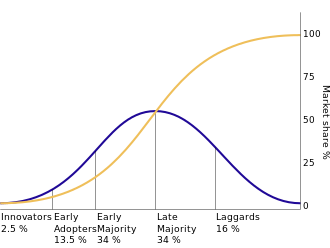
There are some generic models and patterns of technology adoption and diffusion that are largely independent of the specific technology in question. When Everett Rogers and his colleagues did the original research on the adoption of new technology by farmers in the 1950s, it made sense to identify a spectrum of attitudes, with "innovators" and "early adopters" at one end, and with "late adopters" or "laggards" at the other end. Clearly some people can be attracted by a plausible story of future potential, while others need to see convincing evidence that an innovation has already succeeded elsewhere.
Diffusion of Innovations (Source: Wikipedia)

Obviously adoption by organizations is a slightly more complicated matter than adoption by individual farmers, but we can find a similar spread of attitudes within a single large organization. There may be some limited funding to carry out early trials of selected technologies (what Fersht describes as "sometimes painful experimentation"), but in the absence of positive results it gets progressively harder to justify continued funding. Opposition from elsewhere in the organization comes not only from people who are generally sceptical about technology adoption, but also from people who wish to direct the available resources towards some even newer and sexier technology. The "pioneers" have moved on to something else, and the "settlers" aren't yet ready to settle. There is a discontinuity in the adoption curve, which Geoffrey Moore calls "crossing the chasm".

Note: The terms "pioneers" and "settlers" refers to the trimodal approach. See my post Beyond Bimodal (May 2016).

But as Fersht indicates, there are some specific challenges for RPA in particular. Although it's supposed to be about process automation, some of the use cases I've seen are simply doing localized application patching, using robots to perform adhoc swivel-chair integration. Not even paving the cow-paths, but paving the workarounds. Tool vendors such as KOFAX recommend specific robotic types for different patching requirements. The problem with this patchwork approach to automation is that while each patch may make sense in isolation, the overall architecture progressively becomes more complicated.

There is a common view of process optimization that suggests you concentrate on fixing the bottlenecks, as if the rest of the process can look after itself, and this view has been adopted by many people in the RPA world. For example Ayshwarya Venkataraman, who describes herself on Linked-In as a technology evangelist, asserts that "process optimization can be easily achieved by automating some tasks in a process".

But fixing a bottleneck in one place often exposes a bottleneck somewhere else. Moreover, complicated workflow solutions may be subject to Braess's paradox, which says that under certain circumstances adding capacity to a network can actually slow it down. So you really need to understand the whole end-to-end process (or system-of-systems).

And there's an ethical point here as well. Human-computer processes need to be designed not only for efficiency and reliability but also for job satisfaction. The robots should be configured to serve the people, not just taking over the easily-automated tasks and leaving the human with a fragmented and incoherent job serving the robots.

And the more bots you've got (the more bot licences you've bought), the challenge shifts from getting each bot to work properly to combining large numbers of bots in a meaningful and coordinated way.  Adding a single robotic patch to an existing process may deliver short-term benefits, but how are users supposed to mobilize and combine hundreds of bots in a coherent and flexible manner, to deliver real lasting enterprise-scale value? Ravi Ramamurthy believes that a rich ecosystem of interoperable robots will enable a proliferation of automation - but we aren't quite there yet.


Phil Fersht, Gartner: 96% of customers are getting real value from RPA? Really? (HfS 23 May 2017), With 44% dissatisfaction, it's time to get real about the struggles of RPA 1.0 (HfS, 31 July 2019)

Geoffrey Moore, Crossing the Chasm (1991)

Susan Moore, Gartner Says Worldwide Robotic Process Automation Software Market Grew 63% in 2018 (Gartner, 24 June 2019)

Ravi Ramamurthy, Is Robotic Automation just a patchwork? (6 December 2015)

Everett Rogers, Diffusion of Innovations (First published 1962, 5th edition 2003)

Daniel Schmidt, 4 Indispensable Types of Robots (and How to Use Them) (KOFAX Blog, 10 April 2018)

Alex Seran, More than Hype: Real Value of Robotic Process Automation (RPA) (Huron, October 2018)

Sony Shetty, Gartner Says Worldwide Spending on Robotic Process Automation Software to Reach $680 Million in 2018 (Gartner, 13 November 2018)

Ayshwarya Venkataraman, How Robotic Process Automation Renounces Swivel Chair Automation with a Digital Workforce (Aspire Systems, 5 June 2018)


Wikipedia: Braess's Paradox, Diffusion of Innovations, Technology Adoption Lifecycle


Related posts: Process Automation and Intelligence (August 2019), Automation Ethics (August 2019)

Saturday, May 11, 2019

Whom does the technology serve?

When regular hyperbole isn't sufficient, writers often refer to new technologies as The Holy Grail of something or other. As I pointed out in my post on Chatbot Ethics, this has some important ethical implications.

Because in the mediaeval Parsifal legend, at a key moment in the story, our hero fails to ask the critical question: Whom Does the Grail Serve? And when technologists enthuse about the latest inventions, they typically overlook the same question: Whom Does the Technology Serve?

In a new article on driverless cars, Dr Ashley Nunes of MIT, argues that academics have allowed themselves to be distracted by versions of the Trolley Problem (Whom Shall the Vehicle Kill?), and neglected some much more important ethical questions.

For one thing, Nunes argues that the so-called autonomous vehicles are never going to be fully autonomous. There will always be ways of controlling cars remotely, so the idea of a lone robot struggling with some ethical dilemma is just philosophical science fiction. Last year, he told Jesse Dunietz that he hasn't yet found a safety-critical transport system without real-time human oversight.

And in any case, road safety is never about one car at a time, it is about deconfliction - which means cars avoiding each other as well as pedestrians. With human driving, there are multiple deconfliction mechanisms to allow many vehicles to occupy the same space without hitting each other. These include traffic signals, road markings and other conventions indicating right of way, signals (including honking and flashing lights) to negotiate between drivers, or for drivers to show that they are willing to wait for a pedestrian to cross the road in front of them. Equivalent mechanisms will be required to enable so-called autonomous vehicles to provide a degree of transparency of intention, and therefore trust. (See Matthews et al. See also Applin and Fischer). See my post on the Ethics of Interoperability.


But according to Nunes, "the most important question that we should be asking about this technology" is "Who stands to gain from its life-saving potential?" Because "if those who most need it don’t have access, whose lives would we actually be saving?"

In other words, Whom Does The Grail Serve?


Sally Applin and Michael Fischer, Applied Agency: Resolving Multiplexed Communication in Automobiles (Adjunct Proceedings of the 4th International Conference on Automotive User Interfaces and Interactive Vehicular Applications (AutomotiveUI '12), October 17–19, 2012, Portsmouth, NH, USA) HT @AnthroPunk

Rachel Coldicutt, Tech ethics, who are they good for? (8 June 2018)

Jesse Dunietz, Despite Advances in Self-Driving Technology, Full Automation Remains Elusive (Undark, 22 November 2018) HT @SafeSelfDrive

Ashley Nunes, Driverless cars: researchers have made a wrong turn (Nature Briefing, 8 May 2019) HT @vdignum @HumanDriving

Milecia Matthews, Girish Chowdhary and Emily Kieson, Intent Communication between Autonomous Vehicles and Pedestrians (2017) 

Eric A Taub, How Jaywalking Could Jam Up the Era of Self-Driving Cars (New York Times, 1 August 2019)

Wikipedia: Trolley Problem


Related posts

For Whom (November 2006), Defeating the Device Paradigm (October 2015), Towards Chatbot Ethics - Whom Does the Chatbot Serve?  (May 2019), Ethics of Interoperability (May 2019), The Road Less Travelled - Whom Does the Algorithm Serve? (June 2019), Jaywalking (November 2019)

Sunday, May 05, 2019

Towards Chatbot Ethics

When over-enthusiastic articles describe chatbotics as the Holy Grail (for digital marketing or online retail or whatever), I should normally ignore this as the usual hyperbole. But in this case, I'm going to take it literally. Let me explain.

As followers of the Parsifal legend will know, at a critical point in the story Parsifal fails to ask the one question that matters: "Whom does the Grail serve?"

And anyone who wishes to hype chatbots as some kind of "holy grail" must also ask the same question: "Whom does the Chatbot serve?" IBM puts this at the top of its list of ethical questions for chatbots, as does @ashevat (formerly with Slack).

To the extent that a chatbot is providing information and advice, it is subject to many of the same ethical considerations as any other information source - is the information complete, truthful and unbiased, or does it serve the information provider's commercial interest? Perhaps the chatbot (or rather its owner) is getting a commission if you eat at the recommended restaurant, just as hotel concierges have always done. A restaurant review in an online or traditional newspaper may appear to be independent, but restaurants have many ways of rewarding favourable reviews even without cash changing hands. You might think it is ethical for this to be transparent.

But an important difference between a chatbot and a newspaper article is that the chatbot has a greater ability to respond to the particular concerns and vulnerabilities of the user. Shiva Bhaska discusses how this power can be used for manipulation and even intimidation. And making sure the user knows that they are talking to a bot rather than a human does not guard against an emotional reaction: Joseph Weizenbaum was one of the first in the modern era to recognize this.

One area where particularly careful ethical scrutiny is required is the use of chatbots for mental health support. Obviously there are concerns about efficacy and safety as well as privacy, and such systems need to undergo clinical trials for efficacy and potential adverse outcomes, just like any other medical intervention. Kira Kretzschmar et al argue that it is also essential that these platforms are specifically programmed to discourage over-reliance, and that users are encouraged to seek human support in the case of an emergency.


Another ethical problem with chatbots is related to the Weasley doctrine (named after Arthur Weasley in Harry Potter and the Chamber of Secrets):
"Never trust anything that can think for itself if you can't see where it keeps its brain."
Many people have installed these curious cylindrical devices in their homes, but is that where the intelligence is actually located? When a private conversation was accidentally transmitted from Portland to Seattle, engineers at Amazon were able to inspect the logs, coming up with a somewhat implausible explanation as to how this might have occurred. Obviously this implies a lack of boundaries between the device and the manufacturer. And as @geoffreyfowler reports, chatbots don't only send recordings of your voice back to Master Control, they also send status reports from all your other connected devices.

Smart home, huh? Smart for whom? Transparency for whom? Or to put it another way, whom does the chatbot serve?


Shiva Bhaskar, The Chatbots That Will Manipulate Us (30 June 2017)

Geoffrey A. Fowler, Alexa has been eavesdropping on you this whole time (Washington Post, 6 May 2019) HT@hypervisible

Sidney Fussell, Behind Every Robot Is a Human (The Atlantic, 15 April 2019)

Tim Harford, Can a computer fool you into thinking it is human? (BBC 25 September 2019)

Gary Horcher, Woman says her Amazon device recorded private conversation, sent it out to random contact (25 May 2018)

Kira Kretzschmar et al, Can Your Phone Be Your Therapist? Young People’s Ethical Perspectives on the Use of Fully Automated Conversational Agents (Chatbots) in Mental Health Support (Biomed Inform Insights, 11, 5 March 2019)

Trips Reddy, The code of ethics for AI and chatbots that every brand should follow (IBM 15 October 15, 2017)

Amir Shevat, Hard questions about bot ethics (Slack Platform Blog, 12 October 2016)

Tom Warren, Amazon explains how Alexa recorded a private conversation and sent it to another user (The Verge, 24 May 2018)

Joseph Weizenbaum, Computer Power and Human Reason (WH Freeman, 1976)


Related posts: Understanding the Value Chain of the Internet of Things (June 2015), Whom does the technology serve? (May 2019), The Road Less Travelled (June 2019), The Allure of the Smart Home (December 2019), The Sad Reality of Chatbotics (December 2021)

updated 4 October 2019

Friday, August 21, 2015

Technology Hype Curve 4

@dgwbirch applies the Gartner Hype Curve (it's not a cycle) to itself.


Obviously I don't speak for Gartner, but I imagine they might be puzzled at Dave's extension of the notion of technology to something that is essentially a conceptual tool. So where are the limits of the tool, and is Dave just being mischievous?

In any case, perhaps different stakeholders are at different stages of the curve. Gartner itself has always been in the Slope of Enlightenment, deploying the Hype Curve for an ever-increasing number of instances of how the tool can benefit Gartner and its clients.

Meanwhile, if some people have become disillusioned with the Hype Curve, as Dave claims, there will always be a new generation of CIOs with inflated expectations. So that's alright then.


See previous posts

Technology Hype Curve 1 (September 2005)
Technology Hype Curve 2 (July 2009)
Technology Hype Curve 3 (August 2009)
Category: Hype

Tuesday, February 12, 2013

The Asymmetry of Hype

@oscarberg is "so tired of the question 'is social media a hype?' Obviously it's not, so please stop asking this question!"

Hype (short for hyperbole) is a property of discourse, not of technology itself. Discourse about social media can oscillate between hyperbole and bathos. The same is true of any other technical or sociotechnical innovation or practice. The medium is not always the message.


Aaron Kim, Social software adoption: Riding the hype curve (December 2012)

Sunday, February 10, 2013

The Dynamics of Hype

A common feature of technology hype is the shifting relationship between signifier (a word or phrase) and signified (what the word is supposed to mean). Technology concepts may emerge slowly through a complex social process; the sociologist Bruno Latour refers to these emerging concepts as Black Boxes.

I found the following observations in a discussion of the hype around "nanotechnology".

  • The relationship between the signifier and the signified can change over time.
  • People can argue about what a signifier means.
  • Signifier-signifed relations can be political.
  • One sees an ideological landscape of explicit and implicit assumptions, with much competition to establish definitions.
 edited by Susanna Hornig Priest, Sage 2010.

The Encyclopedia makes the point that "nanotechnology" is an emerging technology - incomplete and with unclear consequences (ibid p 486) and identifies "nanotechnology" as a polysemic or multivalent signifier: in other words, the same thing can mean very different things to different people.

What the Encyclopedia says about "nanotechnology" is true of many technologies, especially those that are most overhyped: at present, these would include Big Data and Cloud.

Innovative concepts typically go through some or all of the following phases.

1. People starting to talk about the concept. (Assertion)

2. Other people rejecting the concept as meaningless, dangerous and/or unnecessary, while trying to bundle it together with earlier concepts. (Denial)

3. Vendors trying to attach the concept to a wide range of new and existing products. (Divergence)

4. Some common understanding may emerge as to what the concept really means. (Convergence)

5. A split appears between a narrow purist interpretation of the concept and a broader more ambitious interpretation. (Divergence)

6. Several different industry groups develop alternative definitions. Subcategories emerge. (Convergence/Divergence)

7. Vendors produce deliberately confusing statements, wishing to show both that they confirm to the standard(s) and also differentiate themselves from the standard(s).  (Divergence)

8. The concept only stops changing its meaning when it ceases to be interesting. (Convergence/Death)


By the way, denial often follows Kettle Logic. That concept doesn't make sense, and even if it did it wouldn't be technologically feasible, and anyway we already have a perfectly good word for it and lots of people are already doing it so we don't need a new word.


If you compare the Gartner Hype Curve (it's not a cycle) from one year to another you will see some of the consequences of this shifting and subdividing terminology. For example, Thoran Rodrigues notes that different cloud technologies are in different points of the curve and wonders about the shifting positioning of Cloud Computing from one year to the next. (The cloud's place in the hype cycle, Tech Republic Sept 2012).

The Gartner Hype Curve (it's not a cycle) is supposed to track hype rather than reality, so we may suppose that it describes the trajectory of the signifier rather than the signified. There are many terms that have become discredited or unfashionable, but the underlying technologies have been quietly adopted by many large organizations. Conversely, there are many terms that are still "hot" but whose adoption is problematic. What Gartner's Hype Curve (it's not a cycle) fails to explain is the evolving relationship between the signifier and the signified.


Updated 29 July 2014

Thursday, December 10, 2009

What is Technology Maturity?

@madgreek65 asks whether cloud computing is "mature", and whether it matters (What the masses are missing about the cloud).

I suggest that there are several characteristic features of a technology or product, indicating whether it is mature or immature.


Immature
Mature
Product Stability
Subject to frequent and significant improvements. In a state of "permanent beta".
Stable. New releases are fairly predictable upgrades.
Conceptual Stability
Terminological disputes. Disagreements as to what the technology is "all about".
Terminology "taken for granted".

Technology-in-use
A small number of early adopters trying ambitious stuff. Little consensus about how the technology should be deployed and used.
A large user community doing similar stuff. Use of the technology has become standardized "best practice".
Growth
Large untapped market. Rapid growth possible, under favourable conditions.
Relatively little scope for further growth.
Metrics
Absent or unreliable
Systematized
Adoption Risk
High
Low
Adoption Benefits
Potentially high
Moderate

This notion of technological maturity has the following consequences.

1. It is unrelated to quality or value. A mature technology or product can be unimaginative, boring, almost obsolescent, whereas an immature technology can be visionary, exciting in conception and engineered to the highest standards.

2. Maturity is as much to do with the community of users (technology-in-use) as about the designed products (technology-as-built).

3. The adoption roadmap for an immature technology may be rather complicated. One of the main reasons for this is that the adoption programme needs to bridge the gap between technology-as-built and technology-in-use. There is also a common preference for a cautious stepwise approach - pilot projects, proof of concept and so on. But the stakes can be much higher.

As Mike points out, for any technology that is in the hype phase, there is a lot of resistance to change, and this is certainly true for cloud computing. Mike suggests that a lower-risk adoption approach will win over the sceptical.
"The reason why I encourage those who are pessimistic about the cloud to try one of these low risk scenarios is once they see how easy it is, how productive they can be, and how inexpensive the project will be, then maybe they will see the value and investigate further."
For many people, this is the preferred approach for an immature technology. However, there are some specific risks associated with a slow adoption curve, which I shall discuss in a future post.


See also previous post: CEP and technological maturity

Wednesday, September 02, 2009

A Silver Lining for Industry Analysis?

You're everywhere and nowhere, baby,
that's where you're at
Going down the bumpy hype-curve in your sorting hat
Flying across the country and getting fat
Saying everything is groovy
when your tires are flat

And it's hi-ho silver lining
anywhere you go now, baby
I see your sun is shining but I will make a fuss
Though it's obvious

Flies are in your pea soup, baby
they're waving at me
Anything you want is yours now,
only nothing's for free
Life's a-gonna get you someday,
just wait and see
So put up your beach umbrella
while you're watching TV

And it's hi-ho silver lining
anywhere you go, well, baby
I see your sun is shining but I will make a fuss
Though it's obvious

[with apologies to Scott English and Larry Weiss]

Friday, August 21, 2009

Magic Quadrant or Sorting Hat?

What is it about analysts and 4 quadrant models (asks @aleksb6 )? Were x and y coordinates so firmly etched in our brains that we can't get away from it?

I presume Aleks is talking about 4-quadrant models produced by software industry analysis firms, such as Gartner's Famous Magic Quadrant, which is a bit like the Hogwarts Sorting Hat.
  • Leaders: Gryffindor
  • Challengers: Slytherin
  • Visionaries: Ravenclaw
  • Niche Players: Hufflepuff
Nate Orenstam (Gartner Magick Quadrante) offers a similar mapping - Finders, Keepers, Losers, Weepers - together with a cynical explanation of the x and y axes.

A quick internet search for Gartner's Magic Quadrant yields many hits from software vendors boasting that their product has been sorted into Gryffindor, presumably because these vendors believe that this quadrant implies some kind of endorsement by Gartner. And Oracle's Billy Cripe tweeted triumphantly "Oracle WIN!" when his own product was sorted into Gryffindor.

As Mark Whitehorn explains (Is Gartner's Magic Quadrant really magic?), Gartner actually collects a considerable amount of data before summarizing everything down to a simple static picture. The quadrant is not the analysis, it is merely a simple visual summary of the analysis. And as Alan Pelz-Sharpe of CMS Watch asserts,
It is both the beauty and the curse of the MQ that it dramatically simplifies a marketplace. (De-mystifying the Gartner ECM Magic Quadrant, September 2007)

But what is the methodology behind the analysis? According to Tony Byrne, another CMS Watch analyst,
Many of Gartner's "strengths" and "cautions" have to do with a vendor's "marketing effectiveness," "messaging," and "awareness." Things that matter to investors and other vendors, but not so much to buyers. (Looking beyond the magic quadrant to find the nitty-gritty, August 2009)
Thus like the equally famous hype curve, it tells you more about marketing and image than about the intrinsic qualities of the technology. This may be one of the reasons why Open Source sometimes gets a poor deal.

Of course, Gartner's fine print strikes a note of caution.

Gartner does not endorse any vendor, product or service depicted in the Magic Quadrant, and does not advise technology users to select only those vendors placed in the "Leaders" quadrant. The Magic Quadrant is intended solely as a research tool, and is not meant to be a specific guide to action.

But obviously the vendors placed in the "Leaders" quadrant don't want you to read this.

See also


Responding to a range of criticism, Gartner analyst Jim Holincheck (Misunderstanding Magic Quadrants, June 2009) makes the following points.

1. "Sometimes you will also hear criticism that Ability to Execute and Completeness of Vision do not matter as decision criteria for customers. I think the evaluation criteria within Ability to Execute and Completeness of Vision give a well-rounded view of a vendor and its place in a particular market and that is really the point of a Magic Quadrant."
Jim thinks the Magic Quadrant gives a "well-rounded view", but other people don't see it like that. In any case, this is not an answer to the criticism that the dimensions of the quadrant are not relevant to customer decisions.

2. "A 2×2 matrix is a really convenient way of showing the relative comparison of vendors."
Convenient to Gartner and the winning vendors obviously.

3. "There is a perception out there that clients basically will look at a MQ and put the vendors in the Leaders quadrant on their short list. There is no doubt that some clients do that. They shouldn’t, but they do."
So Gartner accepts no responsibility for clients misusing the quadrant.

4. "More importantly though, most clients will set up an inquiry (or a series of inquiries throughout the selection process) with an analyst to discuss their specific requirements. ... The interactions we have customers and Gartner clients gives us perspective to tailor our advice for customer-specific needs."
Thus what Gartner really wants is to sell more detailed advice.
5. "Is the Magic Quadrant a good tool to use to make a vendor selection? It can be."

I thought he said that people shouldn't do that. Now he's saying it might be okay after all. What's the recipe today, Jim?


Related posts

The Magic Sorting Hat is Innocent, OK? (March 2010)
Two Dimensions of Trust (April 2012)
Inside the Whale (November 2014)
Into the Matrix (October 2015)

Tuesday, August 11, 2009

Technology Hype Curve 3

"Gartner predicts Twitter fall from grace, advises CIOs to wait before deploying" (V3.co.uk 11th August 2009)

The Hype Curve measures public perception of a given technology. The points on the curve are labelled in terms of perception and opinion ("buzz of expectation", "slough of despond", "renaissance of hope" and "liberal enlightment" - or something like that anyway).

Surely the sensible advice to CIOs is to discount public perception, and base technology judgements as far as possible on technological reality rather than hype.

  1. Don't adopt something simply because it's popular.
  2. Don't NOT adopt something simply because it's NOT popular.

It's certainly possible to find cautionary Gartner statements to this effect. But the emphasis of Gartner advice (at least as glossed by V3) seems to contract the second point. Don't adopt Twitter, says Gartner, because the hype curve will turn against you. In other words, base your technology judgement on the hype curve after all!

Apart from CIOs who are so stressed-out or weak-minded that they like safety in numbers, the people who really value this kind of prediction are the software vendors. For them, the hype curve (as well as the Magic Sorting Hat) may help predict their likely product sales as well as the effectiveness of a given marketing campaign, and help plan their investment in certain products.

And of course Gartner wants the hype curve to be perceived as accurate and relevant. Gartner benefits commercially if the majority of CIOs gregariously (herd-like) follow the Gartner advice. "Thinking with the majority". Even if it is confusing hype with reality.

Update: See also Geek and Poke's Gartner Hype Cycle Version 2.0 (via Cloud Ave)

Friday, July 03, 2009

Technology Hype Curve 2

I wrote a critique of the #Gartner Technology Hype Curve (it's not a cycle) back in September 2005, pointing out some of the reasons why it shouldn't be taken too seriously.

Obviously I'm not arguing with the existence of the phenomenon of hype, but the evidence that this phenomenon follows a standard curve looks extremely weak. The hype curve appears to make falsifiable predictions about the expected hype-status of a given technology on a given future date. If we are being asked to take this curve as serious empirical science, we need to see some kind of scientific proof - for example, looking at the accuracy of these predictions, and using empirical data to calibrate the shape of the curve.

But although this curve has been used by Gartner for over twenty years, I have not seen any statistical analysis, whether from Gartner or anyone else, that would help us to assess how accurate these predictions have been. The shape of the curve seems to have remained remarkably stable, despite a widespread belief that innovation has been getting faster. I made all these points in my earlier post.

I understand that some people use the hype curve as a planning tool, to decide the appropriate investment and placement of technology. I'd be very interested to know how this works, and what practical conclusions can be drawn from the curve.

Another methodological problem with tracking technology hype through time is that technological jargon isn't always stable - the meaning and identity of the hyped items shift over time. So the same buzzword on the curve in different years doesn't necessarily refer to the identical technology - we might collectively change our minds as to what exactly a given buzzword really signifies. As Vinnie Mirchandani puts it: "Category names morph as they mature".

Technology concepts may emerge slowly through a complex social process; the sociologist Bruno Latour refers to these emerging concepts as Black Boxes. If we accept that there may be a separation between the perceived progress of technology (as represented through hype and jargon) and the actual progress of technology (which we may sometimes only be able to infer indirectly), then the hype curve presumably measures the first of these. And if that's true, what value can the hype curve provide to whom?


Parts of this post were contributed to a discussion on The Enterprise Architecture Network, via Linked-In.
See also Jorge Aranda: Cheap Shots at the Gartner Hype Curve (October 2006)
See also Vinnie Mirchandani: Un-hyping the Gartner Hype Cycle (August 2009)
And see my later posts Technology Hype Curve 3, Magic Quadrant or Sorting Hat

Friday, September 16, 2005

Software Hype Curve

The Gartner Group produces a large range of technology trends and predictions, based on a so-called Hype Cycle model. (The term Hype Cycle implies that things come round again. But the model is not cyclic, so it is more accurate to refer to it as a Hype Curve model.) I have just been looking at a Gartner document that includes curves for 1995 and 2005.

I have posted some comments on my Demanding Change blog (formerly known as Innovation Matters) concerning the degree of rigour and empirical support underpinning Gartner's analysis. What I want to comment on here are some specifics about some of the software technologies we've been tracking ourselves.

Issue
Example
Comment
Interrelated technologies SOA is just entering the trough of disillusionment. but will be plateau-ing in 2-5 years.Web Services-enabled Business Models is a bit further behind. Meanwhile Internal Web Services is reaching the plateau of productivity. When technologies are interrelated, there is likely to be some temporal coupling between their dissemination and adoption.
Implied technologies
MDD hasn't peaked yet, apparently. Some analysts are predicting that MDD will peak when Microsoft actually ships its DSL + Software Factory products.
Gartner's selection of technologies omits some key enablers.
Vendor-specific technologies
At present, DSL + Software Factory is a Microsoft-specific initiative.
Gartner tries to talk about all technologies as if they were vendor-independent, but this doesn't always work.
Absent technologies
CBD (CBSE) doesn't get a mention. Perhaps some people now see it as having been a blind alley, while others see it as common-sense design.
CBD (CBSE) clearly means different things to different people.
Deja vu technologies
Some might consider we have been through the MDD hype curve once. Except it was called CASE the first time. Plus ca change ...
So maybe it should be a Hype Cycle after all!

Based on discussion with John Dodd, Oliver Sims and Lawrence Wilkes.